Honoring Courage in Leadership: Celebrating Alberto Carvalho & 25 Years of Family Power
Families In Schools (FIS) is celebrating its 25th anniversary this year, including a benefit gala on June 3, 2026, that will honor several individuals who embody FIS’s mission. As we lead up to our gala in June, FIS will be releasing one profile every week on each of our gala’s honorees to celebrate their leadership stories and demonstrate how they honor the spirit of their award.
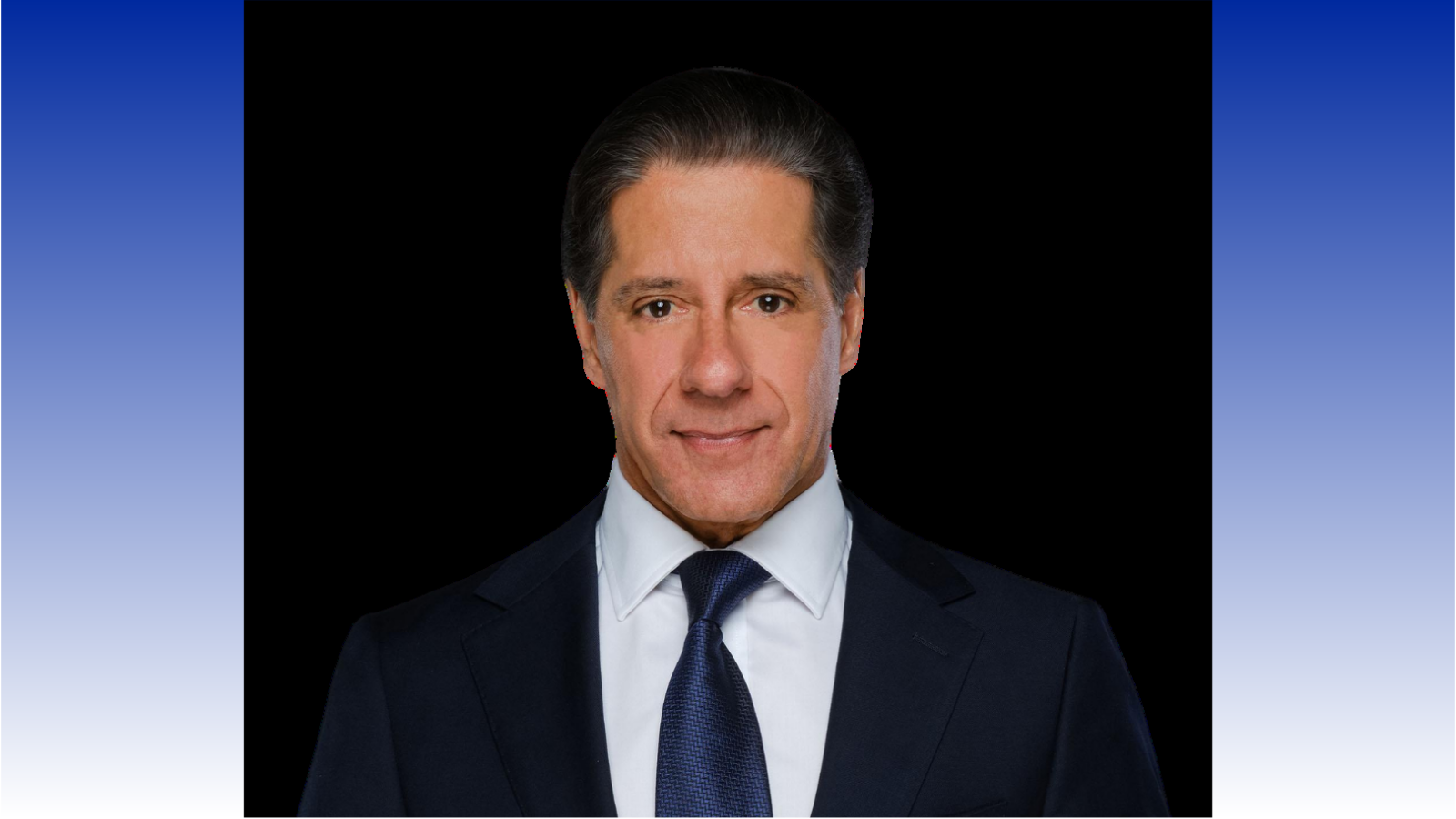
For the last of our award recipients, Families In Schools is honored to present the Courage in Leadership Award to Alberto Carvalho. In times of fear and uncertainty, some leaders choose courage. This award honors district leaders, principals, teachers, and staff who have stood fearlessly with families—protecting children’s safety, dignity, and belonging in the face of ICE aggression. Their moral leadership reminds us that schools must be sanctuaries where every child is safe, seen, and free to dream.
“Courage isn’t about doing what’s right when it’s easy. It’s about staying true to your values when it’s hard and the stakes are high,” said FIS President and CEO Yolie Flores. “This past year, Superintendent Carvalho has modeled what it means to be a courageous leader and to stand with families.”
Protecting Schools as Safe Spaces for Learning
On Monday, April 7, 2025, 700 children headed into class at Russell Elementary School in South Los Angeles. A few minutes later, three men showed up at the school office and said they were with the Department of Homeland Security. They started asking about several students between first and sixth grade, saying they were conducting a wellness check on children that had arrived unaccompanied at the border.
Principal Alejandra Miramontes asked for identification. When she went to write down their names, they snatched their IDs back and claimed they had authorization from the children’s caregivers and legal standing to access the school.
Principal Miramontes asked for proof. When they didn’t provide it, she turned them away.
Two hours later, almost the same thing happened again at Lillian Street Elementary School, where the school’s principal, Maria Gomez, also turned the men away.
These two principals weren’t going rogue. They did exactly what they had been trained to do by the Los Angeles Unified School District (LAUSD) under the leadership of Superintendent Alberto Carvalho.
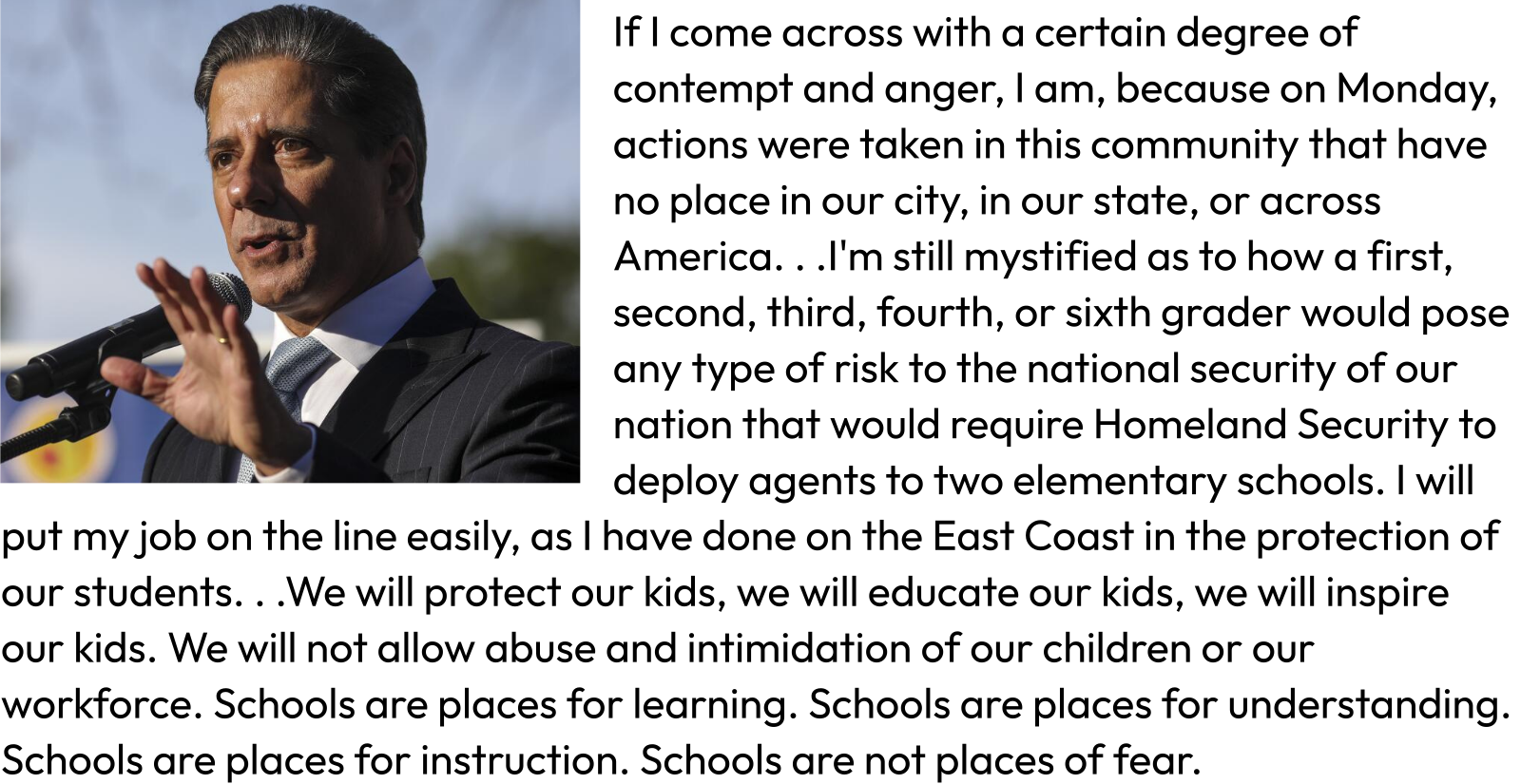
In a press conference on the afternoon of the incidents, Carvalho said that school systems have not only a professional responsibility to protect and educate young people, but a moral one:
It turned out the agents had lied about having permission from caregivers. They never came back.
Preparing for the Unthinkable
It is not normal for agents from Homeland Security to go looking for a first grader at an elementary school. However, little has been typical since Donald Trump was elected president following a campaign pledge to escalate immigration enforcement that spewed hate-filled rhetoric.
About half of all kids in California have at least one immigrant parent. One in five live in mixed-status families with a sibling or parent who is undocumented, numbers that are even higher in LAUSD.
Since 2011, Immigration and Customs Enforcement (ICE) has followed an internal “sensitive locations” policy. Under it, ICE was generally barred from enforcement at schools, hospitals, courthouses, and places of worship, grounded in the idea that people should be able to access health, education, and services without fear. After he was elected, Trump rescinded this guidance.
LAUSD, with one of the most diverse student bodies in the nation, has had a policy since 2017 of not voluntarily cooperating with immigration enforcement actions and not sharing information about the immigration status of students and their families.
After Donald Trump won the 2024 presidential election, the school board reaffirmed its commitment to being a “sanctuary district” and to the We Are One campaign to formalize and amplify district efforts. Throughout spring 2025, LAUSD trained school staff on how to talk with and support students and what to do if agents showed up at their school. The district partnered with community organizations to provide know-your-rights resources and workshops to parents on what to do if immigration agents came to their workplace or residence. They also helped families plan for the worst with a Family Preparedness Care Packet with details on rights, legal aid, and naming caregivers for their children. LAUSD continues to run a family hotline 24 hours a day, seven days a week.
From Undocumented Student to National Superintendent of the Year
Carvalho made protecting immigrant families not just a priority but policy for LAUSD, ensuring clarity and coordination across more than 83,000 staff at over 1,000 schools.
“I would be the biggest hypocrite in the world, regardless of my position today, if today I did not fight for those who find themselves in the same predicament I faced over 40 years ago when I arrived in this country at the age of 17 as an undocumented immigrant,” Carvalho told CBS News. “Education made me and saved me.”
Carvalho was born in Portugal to a father who worked as a custodian and a mother who worked as a seamstress. One of six children, he came to the United States in the early 1980s. As a 17-year-old undocumented immigrant, he worked mostly in construction and at restaurants as a dishwasher, ending up homeless for a time.
He went on to complete his college degree and become a physics, chemistry, and calculus teacher in Miami. He rose through the ranks and ultimately became superintendent of Miami-Dade County Public Schools (M-DCPS) in 2008, the fourth-largest school district in the United States. Under his leadership, it became one of the nation’s highest performing school systems, and he was named 2014 National Superintendent of the Year before being hired to lead LAUSD in 2022.
Shortly after the 2025 incidents, NPR asked Carvalho how far he would go to stand up to the Trump administration, despite the potential repercussions. He replied: