Get to Know Your Board Member: Interview with LAUSD’s Karla Griego
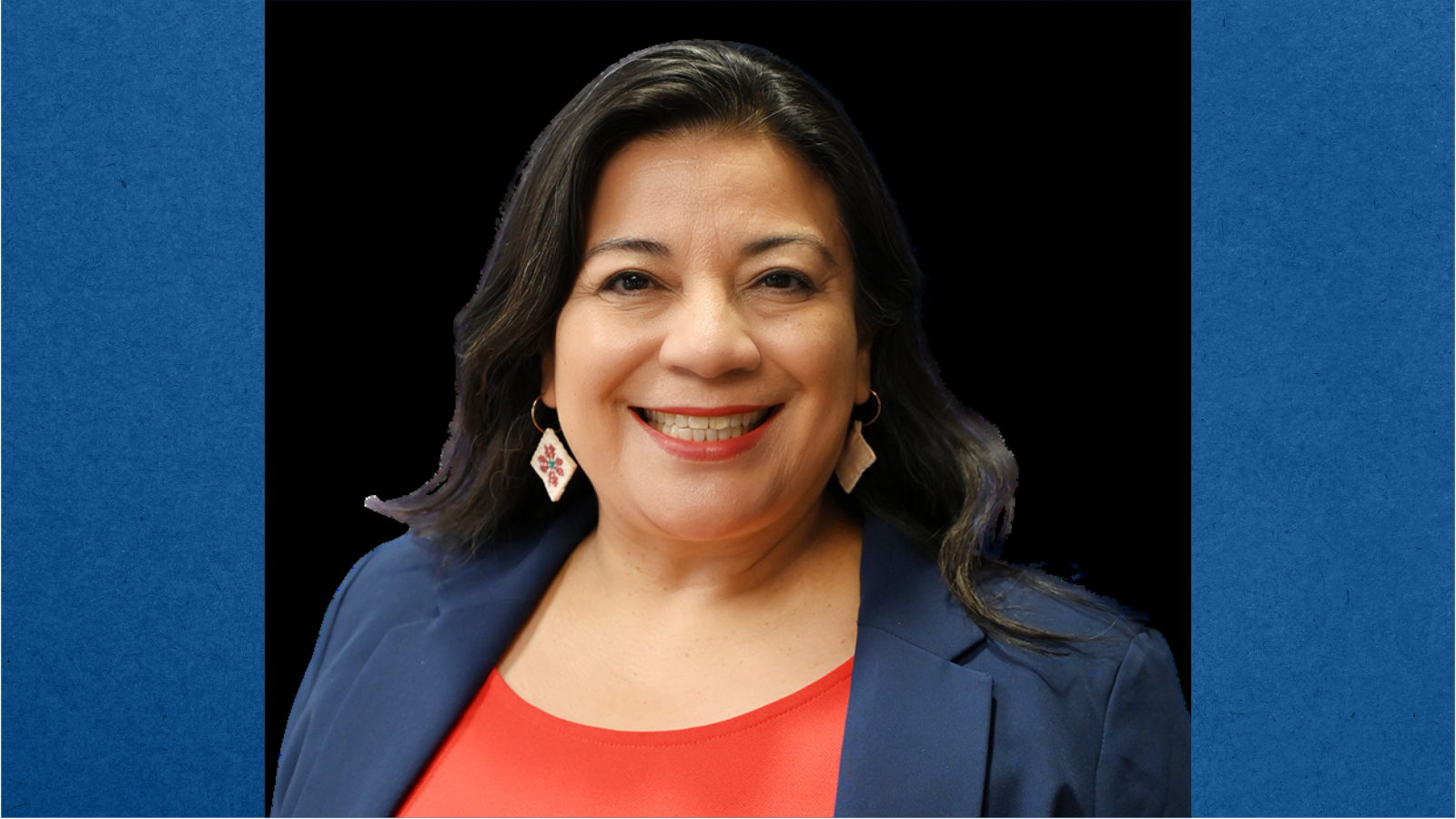
Last month, FIS launched a “Get to Know Your Board Member” interview series with each member of LAUSD’s Board of Education. School board members can enact meaningful change in a child’s education journey, so parents or caregivers should know who they are and what their priorities are. See the profiles to date.
This month, we spoke with Karla Griego, who represents Board District 5 (Northeast, South, and Southeast LA, including East Hollywood, Eagle Rock, Koreatown, Pico-Union, South Gate, Huntington Park, and more).
Born in El Salvador and raised in LA, Griego has served on the LAUSD board since 2024. She chairs both the Curriculum and Instruction committee and the Special Education committee and serves on the School Safety and Climate committee. She’s a special education teacher and a former Community Schools Coordinator in LAUSD; a UTLA Area Chair, board member, and chapter chair; and a founding member of Reclaim Our Schools Los Angeles (ROSLA).
Can you share a bit about your life story, and what inspired you to become a board member?
I was born in El Salvador and came to the U.S. in 1978 when I was five, so I had the very typical immigrant experience. From a young age, I understood what imperialism was and the U.S.’s role in creating the conditions that pushed Salvadorans like my family to this country. At the time, we were a minority in Los Angeles, and not too many people knew about El Salvador. No one knew who I was or where I came from and usually lumped me into the Mexican community. However, I was blessed that my parents taught me to have pride in my culture.
When we arrived in the U.S., I didn’t know any English. I learned before my parents did, so I was translating for them in the first grade. I took the lead to do the things they needed support with, and I was the oldest of three kids, so I’ve always been supporting and leading my family.
I grew up in a studio apartment with my family of five on Beverly and Normandie, which was the hub of Salvadorans back then. In the seventh grade, I was bused to Reseda to attend Sherman Oaks Center for Enriched Studies, and I remember that the buses for the kids from the city of LA were parked at the back of the school, while the kids who were bused from the Valley—who were almost all white—were parked at the front of the school. Even though it wasn’t quite clear then, I could still feel the difference in how different student groups were treated.
In high school, I delved into the anti-apartheid movement, working with a coalition of students to do sit-ins at the South African Consulate, so that spirit of activism has always been in me. I went to college at UC Berkeley and decided to be a teacher after working as a development director. I returned to LAUSD, became a special education teacher, and fell in love with it. I also became active in UTLA to change the conditions for our students’ learning and for teachers.
I have my own children now, and they’re very active advocates as well. Over time, I’ve thought about how a lot of the decisions made at the top level at LAUSD aren’t connected to our students’ experiences. These decisions are based on research and studies, but they don’t know students’ real stories. We need that voice, so as a parent and special ed teacher, I made sure that voice was there. Those were my motivations for running to be a school board member, and I’m so glad I’m at the table now to bring that perspective and help with our decisions.
What have been some of your proudest achievements during your time serving on the board?
My proudest achievement so far has been getting funding for the three big buckets I believe in: LGBTQ+ resources, the expansion of our Dream Centers, and the Black Student Achievement Plan. When I ran for the LAUSD board, those were part of my priorities, and when I first joined, I wanted to pass a resolution that named these as areas of focus and investment for LAUSD.
When I started on the board, Trump had just gotten back into office, and he already had LAUSD on his radar, so these commitments were a little dangerous to put on paper. But at the end of the day, my goal was that these buckets would be funded so students could have these supports. The attacks on our most vulnerable students started from the beginning of Trump’s new term, so the district had to be at the very forefront of defending them. That is our duty.
My community also saw these buckets as priorities. In my first year, I had five different budget conversations throughout my district, where people shared what was important to them. These buckets came up, so I’m proud that I was able to advocate and secure them for my community.
Since then, I’ve continued to work with my district and constituents. I hold monthly meetings online where we start by asking, “What does safety look like to you? What’s important to you?” Creating space for people to come together, support one another, and share ideas is very important to me, and it’s what parents and the community want, so I’m very proud of that too.
What message would you like to share with our families, and how can families partner or work alongside you?
I want families to know that they have a lot of power. What time they’re giving to us and the district is valuable since they are our co-thinkers and co-creators. They shouldn’t be passive members just casting a vote, which happens in a lot of parent engagement situations. I want parents to know that that’s not true engagement and that they have the power to affect change.
Our families also need supports and spaces where they feel welcomed. I’ve created spaces like these with the monthly meetings I have with my constituents. At one point, we talked about immigration and not only disseminated information but also learned that parents had organized their own rapid response networks in my district. We invited those parents and community members to share their networks and become a liaison for groups who wanted to do the same. That’s a way parents can partner with me—by sharing their skills and knowledge.
Another way to work with me would be partnering on special education. Special ed is not fully funded in public schools by the government, so I would love to organize with parents to seek more funding. I’m also pushing the district for parent trainings on advocacy and visits with legislators for our community and parent representatives, so I’d love to partner on that.
In times like these, what gives you hope?
I always think of our students—that gives me hope. Young people have passion and are so optimistic. They don’t give up. They fight hard, and when I see students coming to the board to speak up, demand things from us, and call us out, that gives me a lot of hope.
That’s what we need in our society right now. We need people to do the opposite of our government and be brave, courageous, loving, and kind. We need to stand up for people who are being oppressed because we’re currently living with blatant hatred and meanness.
My youngest daughter is 19, and she has that energy, so she gives me a lot of hope. She’s not only a fighter, but she’s also so loving and kind, and I see a lot of kids at our schools who are the same. So they give me a lot of hope—our students and young people.
Is there anything else you want to share with our audience?
On the board, I’m bringing community-based safety to the table. We have a lot of great things happening at LAUSD, but we look at everything in silo, so when crises come up, we’re just responding and not being preventive. A model of community-based safety, where we take classroom practices, mental health and wellness, social-emotional learning, and other factors and coordinate them all at a school site, would help our schools become safer places.
Our schools are like mini-societies, so if we put systems in place and give students and teachers the right tools, we can respond in a kinder, more supportive, and more hopeful way. My resolution is calling out that we need to have those systems in place with more coordinated work done at each school site. It doesn’t ask for investments because we can’t expand our bucket right now, but it is saying that we should use what we have in a strategic, intentional way that maximizes all our resources, like our mental health staff and school climate advocates.
We know that the community also impacts our schools, so working with folks outside of schools to create safe spaces would also be helpful. We want to grow knowledge on community-based safety and look at it through the lens of centering the child with webs of support. That’s one of my priorities right now. (Update: This resolution passed unanimously on May 13, 2026.)